Command ATransfer $80
Reads $100Decision validCommitted
Writes at position 43. The account balance is now $20.
Orisun preserves complete event history and lets a command declare the facts behind its decision. At commit time, Orisun checks that context again. Changed facts reject the write; a valid decision commits atomically and moves to catch-up plus live delivery.
One ordered history.
Every decision checked against the facts it used.
Two commands can read the same valid state and both make a reasonable decision. The second decision becomes unsafe when the first command changes the facts it relied on. Orisun makes that race part of the write contract.
position 42Writes at position 43. The account balance is now $20.
ALREADY_EXISTS: re-read the context and decide again.
Orisun closes the loop between the evidence a command reads, the decision in application code, the atomic write, and the systems that react afterward.
Keep the events behind current state so decisions, projections, audits, and future models share the same durable source of truth.
A command declares the events it relied on. Orisun checks that same subset inside the write transaction and rejects a stale save.
Define consistency with event-content queries across the relevant entities instead of forcing every rule into one fixed stream.
Durable checkpoints provide no-skip, sequential publishing per boundary. Subscribers catch up from storage before moving live.
The application still owns its domain rules. Orisun gives each command a dynamic, content-defined consistency boundary for enforcing them under concurrency.
Two transfers are each valid against the same balance, but not together.
Validate the source balance and both account histories before committing both legs atomically.Concurrent requests act on availability that another request has already consumed.
Scope the write to the product, reservation, and allocation events that determined availability.A step is approved after policy, permissions, or an earlier decision has changed.
Check the workflow and policy events the command evaluated before recording its outcome.An agent proposes an action from facts that changed while it was reasoning or waiting on a tool.
Record the relevant facts as events and reject the action when its declared context is no longer current.Business decisions stay in application code. Orisun owns the transactional context check and the durable path from a committed event to every recovering subscriber.
Query one consistent snapshot of the event history the command needs.
Apply business rules in application code and produce the next events.
Save only if the same declared event subset is still at the expected position.
Publish sequentially per boundary, with storage-backed catch-up before live delivery.
Command Context Consistency lets each decision declare the exact event subset it relies on. Query that context, remember its position, then save only if it remains unchanged. Define and activate the application boundary through the Admin API before entering this command loop.
const latest =
  await client.getLatestByCriteria({
    boundary: 'accounts',
    criteria,
  });
const expectedPosition = latest.contextPosition;

await client.saveEvents({
  boundary: 'accounts',
  query: {
    expectedPosition,
    subsetQuery: {criteria},
  },
  events,
});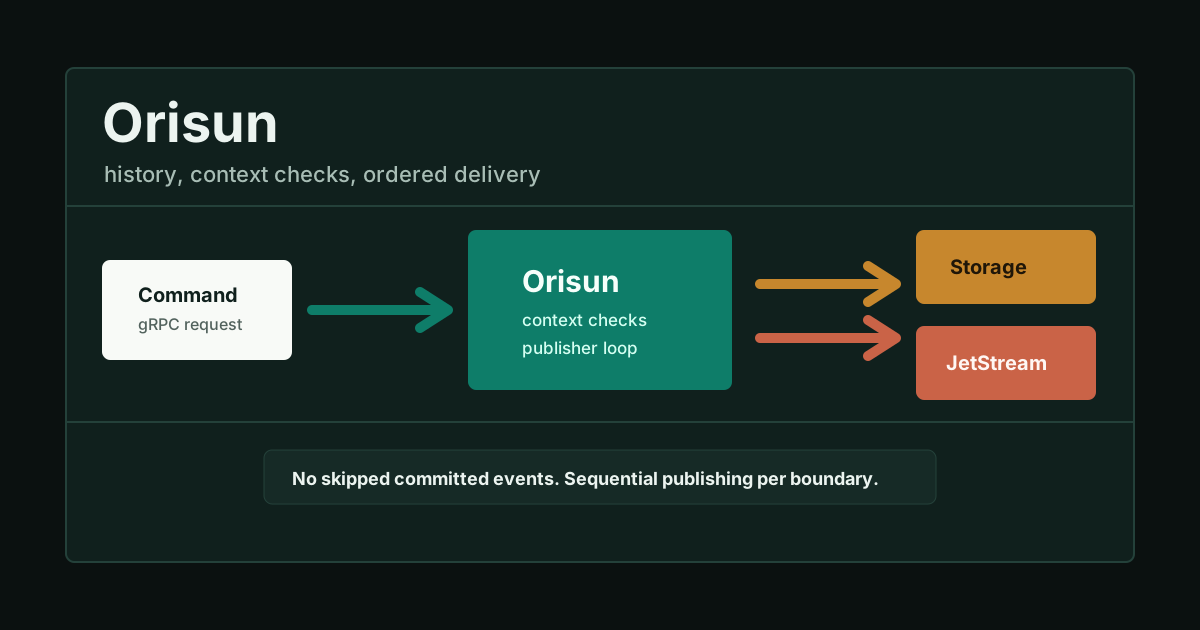
Storage remains the source of truth. Embedded JetStream is the live delivery layer, while durable publisher checkpoints ensure committed events are not skipped. Publishing is at least once and sequential within each boundary.
Start with a complete SQLite server, then use PostgreSQL or the FoundationDB beta backend when the deployment needs multiple nodes or distributed storage.
Single-node production, embedded applications, edge services, and local development.
Multi-node Orisun deployments with mature database operations and shared storage.
Beta clustered backend with ordered key ranges and parallel commits.
Run the event log, context checks, publisher checkpoints, admin state, and embedded JetStream together. The same EventStore API carries forward to every backend.
docker run --rm \
  -p 5005:5005 \
  -e ORISUN_BACKEND=sqlite \
  -e ORISUN_SQLITE_DIR=/var/lib/orisun/sqlite \
  -e ORISUN_NATS_CLUSTER_ENABLED=false \
  -e ORISUN_ADMIN_BOUNDARY=orisun_admin \
  -v orisun-data:/var/lib/orisun \
  orisunlabs/orisun:0.6.1-sqlite